
Your Location:Home>Browse special issues>Research Progress of ZHANG Zhong-jing's Classical Formulae in Treatment of Depression
Research Progress of ZHANG Zhong-jing's Classical Formulae in Treatment of Depression
Depression is a kind of emotional and mental disorder, which is related to many pathogenic factors, such as abnormal metabolism of monoamine neurotransmitters, immune inflammatory reaction, neuroendocrine disorder and so on. it has the characteristics of high disability rate and high recurrence rate, which is seriously harmful to human health. It brings huge economic burden to patients and their families. At present, the commonly used antidepressants in clinic are monoamine oxidase inhibitors, tricyclic antidepressants and selective 5-hydroxytryptamine reuptake inhibitors. Long-term use causes adverse reactions such as cardiovascular, urinary and digestive dysfunction. The multi-target, multi-pathway and multi-mechanism of traditional Chinese medicine has played a great role in the treatment and rehabilitation of depression. At the same time
- The Paper
Research Progress of ZHANG Zhong-jing's Classical Formulae in Treatment of Depression
Abstract:Depression is a kind of emotional and mental disorder, which is related to many pathogenic factors, such as abnormal metabolism of monoamine neurotransmitters, immune inflammatory reaction, neuroendocrine disorder and so on. it has the characteristics of high disability rate and high recurrence rate, which is seriously harmful to human health. It brings huge economic burden to patients and their families. At present, the commonly used antidepressants in clinic are monoamine oxidase inhibitors, tricyclic antidepressants and selective 5-hydroxytryptamine reuptake inhibitors. Long-term use causes adverse reactions such as cardiovascular, urinary and digestive dysfunction. The multi-target, multi-pathway and multi-mechanism of traditional Chinese medicine has played a great role in the treatment and rehabilitation of depression. At the same time, traditional Chinese medicine has gradually become a hot spot in the research and development of antidepressants because of its small side effects and good drug compliance. Especially the ZHANG Zhong-jing's classical formulae with precise medication and rigorous prescription has unique advantages in the treatment of depression. For thousands of years, it has been used clinically by countless doctors in the treatment of various types of depression, with definite curative effects and few side effects. In recent years, clinical research, experimental research, and pharmacological research around ZHANG Zhong-jing's classical formulae for depression have been continuously expanded and deepened. This article reveals the rules of medication of the treatment of depression with ZHANG Zhong-jing's classical formulae from three aspects of Bupleurum class prescription, Gardenia class prescription, and other prescriptions, which is reflected in the study on the composition of prescription, the etiology, and pathogenesis and the symptoms of the treatment. Integrating and classifying ZHANG Zhong-jing's classical formulae's experience in the treatment of depression, mainly expounded from two aspects, clinical research and pharmacological research, summarizing the research perspective and progress of Zhongjing prescription medicine in the treatment of depression in recent years, to excavate, inherit and develop ZHANG Zhong-jing's classical formulae, and provide experience and reference for the treatment of depression from multiple angles and ideas.Keywords:ZHANG Zhong-jing's classical formulae;depression;research progress;Bupleuri Radix class prescription;Gardeniae Fructus class prescription408|229|9 <HTML><H-PDF><L-PDF><XML>Updated:2020-12-10
Effect of Chaihu Jia Longgu Mulitang on Signaling Pathway of PI3K/Akt/GSK3β/β-catenin in Hippocampus Tissue of Rats with Depression
Abstract:ObjectiveTo study the effect of Chaihu Jia Longgu Mulitang on phosphatidylinositol-3-kinases (PI3K)/protein kinase B (Akt)/glycogen synthase kinase 3β (GSK3β)/β-catenin signaling pathway of hippocampus in rats with depression.MethodA total of 120 SD rats were randomly divided into normal group,model group, and low, middle and high-dose Chaihu Jia Longgu Mulitang groups(3.25,6.5,13 g·kg-1), and fluoxetine group, with 20 rats in each group. Except normal group, the depression model was prepared through chronic unpredictable mild stimulation(CUMS). The normal group and the model group were given normal saline with 6.5 g·kg-1 by gavage. Chaihu Jia Longgu Mulitang groups were intragastrically given corresponding herbal drugs 3.75,6.5,13 g·kg-1, while fluoxetine group was intragastrically given fluoxetine 10 mg·kg-1 for 21 days, once a day. Then the depressive behaviors of rats were observed by sucrose preference test (SPT) and forced swimming test (FST). Western blot was used to detect the protein expressions of PI3K,Akt,GSK3β and phosphorylation level.ResultCompared with normal group,the sucrose preference index was decreased significantly,while the immobility time in FST was increased significantly(P<0.01), the protein expressions of PI3K, p-PI3K p110, p-PI3K p85 were decreased significantly (P<0.01), and expressions of Akt, p-Akt Thr308,p-Akt Ser473, p-GSK3β Ser9 and β-catenin were decreased significantly(P<0.01), while the level of GSK3β, p-GSK3β Tyr216 were increased significantly in model group(P<0.05,P<0.01). Compared with model group,Chaihu Jia Longgu Mulitang could increase sucrose preference index and decrease the immobility time in FST(P<0.01), the protein expressions of PI3K p110 and PI3K p85 was increased significantly (P<0.01), levels of Akt Thr308,Akt Ser473, p-GSK3β Ser9, β-catenin were increased significantly (P<0.01), whereas levels of GSK3β, and GSK3β Tyr216 were decreased significantly.ConclusionChaihu Jia Longgu Mulitang could increase protein expression and activity of PI3K in rat hippocampus, activate Akt, inhibit GSK3β kinase activity and prevent β-catenin from degradation, so as to increase PI3K/Akt pathway activity in rat hippocampus, and protect hippocampal neurons.Keywords:depression;Chaihu Jia Longgu Mulitang;chronic unpredictable mild stimulation(CUMS);phosphoinositide 3-kinase(PI3K);glycogen synthase kinase 3β (GSK3β );signaling pathway213|106|13<HTML><H-PDF><L-PDF><XML>Updated:2020-12-10Effect of Modified Suanzaoren Tang on Expression of Glutamate Receptor in Hippocampus of Chronic Restraibt Stress Depression Model Rat
Abstract:ObjectiveTo study the effect of modified Suanzaoren Tang on the expression of excitatory amino acids receptor(EAARs) in hippocampus of rats with chronic depression, and to explore the anti-depressant mechanism of modified Suanzaoren Tang based on excitatory amino acids receptor.MethodSixty SD rats were randomly divided into normal group,model group,and low,middle and high-dose modified Suanzaoren Tang groups,and ketamine group,with 10 rats in each group.Except normal group,the depression model of rats was prepared by using chronic restraint stress(CRS).The normal group and model group were intragastrically(ig) given normal saline.the modified Suanzaoren Tang groups were intragastrically given corresponding herbal drugs 6,12,24 g·kg-1, ketamine group group were given ketamine 0.015 g·kg-1 through intraoeritoneal injection,for 21 days,once a day.Then the depressive behaviors of rats were observed by Morris water maze and novelty feeding experiment.Western blot was used to detect the levels of DAR1,NMDAR2A,NMDAR2B,GluR1,mGluR1,CaMKⅡα and CaMKⅡβ protein expression in rat hippocampus tissue.ResultCompared with normal group,the time of novel ingestion and escape latencywere prolonged significantly(P<0.01), and the time of space exploration was shortened significantly(P<0.01).The levels of NMDAR1,NMDAR2A,NMDAR2B,mGluR1 and CaMKⅡβ expression were increased significantly(P<0.01),while the levels of GluR1 and CaMKⅡα expression were decreased significantly(P<0.01)in model group. Compared with model group,the time of novel ingestion and escape latency were shortened significantly (P<0.01), and the time of space exploration was prolonged significantly(P<0.01).The levels of NMDAR1,NMDAR2A,NMDAR2B,mGluR1 and CaMKⅡβ protein expression were decreased significantly(P<0.01),but the levels of GluR1 and CaMKⅡα expression were increased decreased significantly(P<0.01)in middle and high-dose modified Suanzaoren Tang groups.ConclusionModified Suanzaoren Tang can improve the behavior of chronic depression rats effectly. Its mechanism may be related with reduction the expression of NMDAR1,NMDAR2A,NMDAR2B,mGluR1 and CaMKⅡβ protein ,increase the expression of GluR1and CaMKⅡα protein.Keywords:depression;Suanzaoren tang;hippocampus;glutamic acid;excitatory amino acid receptor(EAARs)179|115|15<HTML><H-PDF><L-PDF><XML>Updated:2020-12-10Effect of Modified Xiao Chaihutang on Expression of EAATs and VGLUTs in Hippocampus of Chronic Restraibt Stress Depression Model Rat
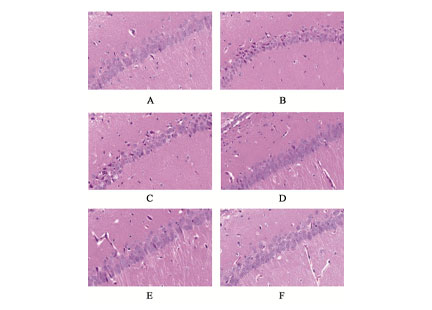
Abstract:ObjectiveTo study the effect of modified Xiao Chaihutang on the expressions of excitatory amino acid transporters(EAATs) and vesicle glutamate transporters(VGLUTs)in hippocampus of rats with chronic depression, in order to explore the anti-depressant mechanism of modified Xiao Chaihutang based on glutamate transport.MethodA total of 120 SD rats were randomly divided into normal group, model group, and low, middle and high-dose modified Xiaochaihutang groups (6.5, 13, 26 g·kg-1) and riluzole group, with 20 rats in each group.Except normal group, the depression model of rats was prepared through Chronic restraint stress(CRS). The normal group and the model group were intragastrically (ig) given normal saline. The modified Xiao Chaihutang groups were intragastrically given corresponding herbal drugs (6.5, 13, 26 g·kg-1), and the Riluzole group was given Riluzole 20 mg·kg-1 through intraoeritoneal injection for 21 days, once a day. Then the depressive behaviors of rats were observed by forced swimming test (FST) and tail suspension test (TST). The level of glutamic acid (Glu) in rats hippocampus was determined by high performance liquid chromatography (HPLC). The mRNA expressions of EAAT1, EAAT2 and EAAT3 in hippocampus were detected by Real-time fluorescence quantitative polymerase chain reaction (Real-time PCR)method. Western blot was used to detect the protein expressions of EAAT1, EAAT2, EAAT3, VGLUT1 and VGLUT2 in rat hippocampus tissue. Nissl staining was used to observe the morphology of hippocampal neurons in rats. Immunohistochemical(IHC)S-P method were used to detect the location expressions of EAAT1, EAAT2 and NeuN proteins in rat hippocampal CA1 region tissue.ResultThe immobility times in FST and TST were increased significantly(P<0.01), the mRNA and protein expressions of EAAT1,EAAT2,EAAT3 were decreased significantly (P<0.01), and as well as the expressions of VGLUT1 and NeuN were decreased significantly(P<0.01), while the level of Glutamate and the expression of VGLUT2 were increased significantly(P<0.01) in model group, compared with normal group. Compared with model group,the immobility times in FST and TST were decreased significantly(P<0.05, P<0.01), mRNA and protein expressions of EAAT1,EAAT2,EAAT3 were increased significantly(P<0.01), and expressions of VGLUT1 and NeuN were increased significantly(P<0.01). However, the level of Glutamate and the expression of VGLUT2 were decreased significantly(P<0.01), and the damage of hippocampal neurons in rats was mild in middle and high-dose modified Xiao Chaihutang groups.ConclusionModified Xiao Chaihutang has an anti-depressive effect. Its mechanism may be related to its up-regulation of expressions of EAAT1, EAAT2, EAAT3 genes and VGLUT1 protein in the hippocampus of depression model rats.Keywords:depression;Xiao Chaihutang;Suanzaoren tang;excitatory amino acid transporters (EAATs);vesicle glutamate transporters (VGLUTs)301|143|5<HTML><H-PDF><L-PDF><XML>Updated:2020-12-10Research Progress of Banxia Houpu Tang in Treatment of Depression
Abstract:Depression is a common emotional disease,causing a heavy burden of disease on patients' families and society.Its pathogenesis is not yet fully understood,andmay be related to inflammation,neurotransmitters,neurotrophicfactors,hippocampal neuronal synaptic plasticity,oxidative stress,etc.Clinical application of Western medicine to treat depression has serious side effects,poor patient compliance,the effective rate is not high,rebound after withdrawal,etc.Traditional Chinese medicine treatment of depression has the characteristics of low side effects and high patient compliance. Depression belongs to the category of depression syndromein traditional Chinese medicine.Traditional Chinese medicine believes that the main symptoms of depression include depressed liver Qi,stagnated Qi transforming into fire,deficiency in heart and spleen,deficiency in heart and lung,stagnation of phlegm and Qi,deficiency of liver and kidney,etc. Banxia Houpu Tang is a classic recipe contained in"Synopsis of the Golden Chamber" by Zhang Zhongjing in the Han Dynasty, it has the effect of treating depression syndrome of stagnation of phlegm and Qi.By searching the literatures of Banxia Houpu Tang in the treatment of depression in Chinese knowledge network database (CNKI),Chinese biomedical literature database (CBM), Wanfang Data, Pubmed, Embase, Web of Science and other databases,we found that both clinical application and experimental research suggest that Banxia Houpu Tang has a significant antidepressant effect. Clinical studies have shown that Banxia Houpu Tang can improve the scores of anxiety scales and depression scales of patients with depression. The antidepressant effect is significant, and the advantages are prominent. Experimental research shows that the antidepressant effect of Banxia Houpu Tang and its effective components may be related to the factors such as intervention of inflammatory response, influence of neurotransmitters, regulation of neurotrophic factors, improvement of synaptic plasticity of hippocampal neurons and reduce oxidative stress,etc. Therefore,this paper reviews several types of depression in the clinical treatment of Banxia Houpu Tang and the related experimental studies of Banxia Houpu Tang.Keywords:Banxia Houpu Tang;depression;clinicalapplication;experimentalstudy;review344|195|7<HTML><H-PDF><L-PDF><XML>Updated:2020-12-10


