
Your Location:Home>Browse special issues>Special topic on application of nucleic acid detection technology system of traditional Chinese medicine
Special topic on application of nucleic acid detection technology system of traditional Chinese medicine
- The Paper
Identification of Scolopendra Dispensing Granules by Allele-specific PCR Enhanced Publication
Abstract:ObjectiveTo establish an allele-specific polymerase chain reaction (PCR) method for identifying Scolopendra dispensing granules, so as to ensure the quality and therapeutic effects of Scolopendra and its preparations.MethodThe primer interval suitable for the PCR was selected based on the cytochrome c oxidase subunit 3(COX-3) gene sequence of Scolopendra, and the single nucleotide polymorphism (SNP) loci of Scolopendra and its adulterants were mined from the interval for the design of specific primers. The samples of Scolopendra and its adulterants were collected. The PCR system was established and optimized regarding the annealing temperature, cycles, Taq enzymes, DNA template amount, PCR instruments, and primer concentrations, and the specificity and applicability of this method were evaluated.ResultThe PCR system was composed of 12.5 μL 2×M5 PCR Mix, 0.4 μL forward primer (10 μmol·L-1), 0.4 μL reverse primer (10 μmol·L-1), 2.5 μL DNA template, and 9.2 μL sterile double distilled water. PCR parameters: Pre-denaturation at 94 ℃ for 3 min, 30 cycles (94 ℃ for 20 s, 62 ℃ for 20 s, 72 ℃ for 45 s), and extension at 72 ℃ for 5 min. After PCR amplification with the system and parameters above, the electrophoresis revealed a bright band at about 135 bp for Scolopendra and no band for the adulterants.ConclusionThe established allele-specific PCR method can accurately identify the medicinal materials, decoction pieces, and standard decoction freeze-dried powder of Scolopendra, as well as the intermediates and final products of Scolopendra dispensing granules, which is of great significance for ensuring the quality and clinical efficacy of Scolopendra and its preparations.Keywords:Scolopendra;dispensing granules;single nucleotide polymorphism (SNP) locus;polymerase chain reaction (PCR)259|416|7 <HTML><H-PDF><L-PDF><XML>Updated:2024-01-15
PCR-RFLP for Distinguishing Periplocae Cortex from Acanthopanacis Cortex and Lycii Cortex Enhanced Publication
Abstract:ObjectiveTo establish a polymerase chain reaction-restriction fragment length polymorphism (PCR-RFLP) method for rapid distinguishing Periplocae Cortex from Acanthopanacis Cortex and Lycii Cortex, so as to avoid the influence of genetic confusion on drug safety.MethodThe DSS-tagged sequences of Periplocae Cortex were obtained from the Chloroplast Genome Information Resource (CGIR) and analyzed to find the enzymatic cleavage sites that were different from those of Acanthopanacis Cortex and Lycii Cortex. The specific enzymatic cleavage site, Cla I, of Periplocae Cortex was selected, on the basis of which the primers for PCR-RFLP were designed. Furthermore, the factors such as annealing temperature, number of cycles, Taq enzyme, PCR instruments, and enzymatic treatment time that may influence PCR-RFLP were studied. The established PCR-RFLP method was applied to the identification of Periplocae Cortex, Acanthopanacis Cortex, and Lycii Cortex samples produced in different regions.ResultThe PCR-RFLP at the annealing temperature of 59 ℃ and with 40 cycles showed clear bands of the samples. When the enzyme digestion time was 30 min. The reaction produced the target bands at about 140 bp and 290 bp for both Periplocae Cortex and its original plant and only a band at about 430 bp for Acanthopanacis Cortex, Lycii Cortex, and their original plants. The method can accurately distinguish Periplocae Cortex from its confounders Acanthopanacis Cortex and Lycii Cortex.ConclusionThe PCR-RFLP method for distinguishing Periplocae Cortex from Acanthopanacis Cortex and Lycii Cortex was established. It has high stability, sensitivity, and applicability, providing a reference for the quality control of Periplocae Cortex, Acanthopanacis Cortex, and Lycii Cortex.Keywords:Periplocae Cortex;Acanthopanacis Cortex;Lycii Cortex;polymerase chain reaction-restriction fragment length polymorphism (PCR-RFLP);molecular identification261|127|1<HTML><H-PDF><L-PDF><XML>Updated:2024-01-15Identification of Original Plants of Lycii Cortex by Multiplex Allele-specific PCR
Abstract:ObjectiveTo identify Lycium chinense and L. barbarum as the original plants of Lycii Cortex simply and efficiently by multiple allele-specific polymerase chain reaction (PCR).MethodThe chloroplast genome sequences of L. chinense and L. barbarum were downloaded from the Chloroplast Genome Information Resource (CGIR), and then IdenDSS was employed to screen out the specific single nucleotide polymorphism (SNP) sites between the two plants. Primer 5.0 was used to design the specific primers, including primers GQ-F/R for identifying L. chinense and primers NX-F/R for identifying L. barbarum. Furthermore, the primer concentration ratio, annealing temperature, cycles, and Taq enzyme were optimized to establish the optimal PCR system and conditions for plant identification. Finally, the applicability of the established method was examined with the plant samples collected from different regions.ResultThe PCR with GQ-F/R∶NX-F/R concentration ratio of 2∶1 at the annealing temperature at 59 ℃ and for 30 cycles showed specific bands at 183 bp and 295 bp, respectively, for L. chinense and L. barbarum samples from different regions.ConclusionThe established PCR approach can simply, rapidly, and efficiently identify the original plants of Lycii Cortex, serving as a new method for the discrimination between L. chinense and L. barbarum. Moreover, the method provides technical support for the research and development of classic famous prescriptions containing Lycii Cortex.Keywords:Lycii Cortex;Lycium chinense ;Lycium barbarum ;molecular identification;polymerase chain reaction234|211|4<HTML><H-PDF><L-PDF><XML>Updated:2024-01-15A Rapid PCR-RFLP Method for Assessing Heterozygosity of Murraya paniculata Germplasm
Abstract:ObjectiveTo establish a rapid method for evaluating the heterozygosity of Murraya paniculata germplasm materials and provide as a foundation for developing germplasm breeding and innovation measures for M. paniculata.MethodSingle nucleotide polymorphisms (SNPs) were screened from the genome resequencing data of 65 plants of M. paniculata. A self-written script was used to transform 20 SNPs into restriction fragment length polymorphism (RFLP) markers. Polymerase chain reaction-restriction fragment length polymorphism (PCR-RFLP) was employed to detect the 20 RFLP markers in 12 M. paniculata germplasm accessions, and the heterozygosity of M. paniculata germplasm accessions was calculated based on the number of enzyme-cutting bands at the 20 RFLP marker sites. Plink was used to calculate the whole genome heterozygosity of 12 M. paniculata germplasm accessions, and the results obtained with different methods were compared.ResultThere was no significant difference in the heterozygosity calculated by the PCR-RFLP method and the genome resequencing method. The PCR-RFLP and genome resequencing methods identified 8 and 9 germplasm accessions, respectively, with a heterozygosity level less than 30%. Seven germplasm accessions with heterozygosity less than 30.00% were calculated by both methods.ConclusionThe PCR-RFLP method established in this study for evaluating the heterozygosity of M. paniculata germplasm demonstrates the precision of 87.5% and the accuracy of 77.8%. This method serves as a reference for developing heterozygosity evaluation methods in other medicinal plant germplasm resources.Keywords:Murraya paniculata ;polymerase chain reaction- restriction fragment length polymorphism (PCR-RFLP);single nucleotide polymorphisms (SNPs);heterozygosity;whole genome resequencing300|135|0<HTML><H-PDF><L-PDF><XML>Updated:2024-01-15Enzyme-linked Immunosorbent Assay in Quality Control of Chinese Medicines: A Review
Abstract:In the quality control of Chinese medicine, the detection of active components and toxic and harmful components are two important links. Although conventional methods such as high performance liquid chromatography and liquid chromatography-mass spectrometry can accurately quantify the above substances, they have shortcomings such as complicated operation, high costs, inability of detection at any time, difficult detection of insoluble and macromolecular substances. Enzyme-linked immunosorbent assay (ELISA) can adsorb antigens or antibodies on the surface of solid carriers and realize qualitative or quantitative analysis of targets by using the specific reactions of antigens and antibodies. This method is praised for the simple operation, high sensitivity, strong specificity, simple requirements for experimental equipment, a wide application range, and low costs. In recent years, ELISA has been widely used in the quality control of Chinese medicine, especially in the content determination of mycotoxins represented by aflatoxin and the qualitative and quantitative analysis of active components. ELISA plays an increasingly important role with its unique advantages, providing new methods and ideas for the rapid quality examination of large quantities of Chinese medicines. This paper reviews the research progress in ELISA for the quality control of Chinese medicine in recent years and prospects its technical development and application prospects, aiming to provide reference and research ideas for further using this method to ensure the quality, safety, and controllability of Chinese medicine.Keywords:quality control of Chinese medicine;enzyme-linked immunosorbent assay;toxic and harmful components;pesticide residue;active component413|294|6<HTML><H-PDF><L-PDF><XML>Updated:2024-01-15Specific PCR for Identification of Astragalus membranaceus var. mongholicus Seeds, A. membranaceus Seeds, and Adulterants
Abstract:ObjectiveTo establish a method based on specific polymerase chain reaction (PCR) that can accurately and rapidly identify Astragalus membranaceus var. mongholicus (AMM) seeds and A. membranaceus (AM) seeds.MethodThe Chloroplast Genome Information Resource (CGIR) and IdenDSS were used to obtain the characteristic DNA fragments of AMM and AM, and the specific single nucleotide polymorphism (SNP) sites of AMM and AM were screened out, on the basis of which the specific primers MG-F/MG-R of AMM and MJ-F/MJ-R of AM were designed. The specific PCR method for identifying AMM and AM was established and optimized, and the specificity and applicability of the method were investigated.ResultThe specific PCR conditions for the identification of AMM were primers MG-F/MG-R, annealing at 62 ℃, and 28 cycles. After PCR amplification and gel electrophoresis, the specific band appeared at about 220 bp, with no band for the seeds of AM or adulterants. The specific PCR conditions for identifying the AM were primers MJ-F/MJ-R, annealing at 58 ℃, and 28 cycles. After PCR amplification and gel electrophoresis, the band appeared at about 150 bp, with no band of AMM or adulterants.ConclusionThe specific PCR method established in this study can accurately and quickly identify the seeds of AMM and AM, which provides a basis for the classification and accurate identification of Astragalus seeds and adulterants.Keywords:Astragalus membranaceus var.mongholicus ;Astragalus membranaceus ;seed;polymerase chain reaction275|239|5<HTML><H-PDF><L-PDF><XML>Updated:2024-01-15Methods for Identifying Seeds of Chinese Medicinal Materials: A Review
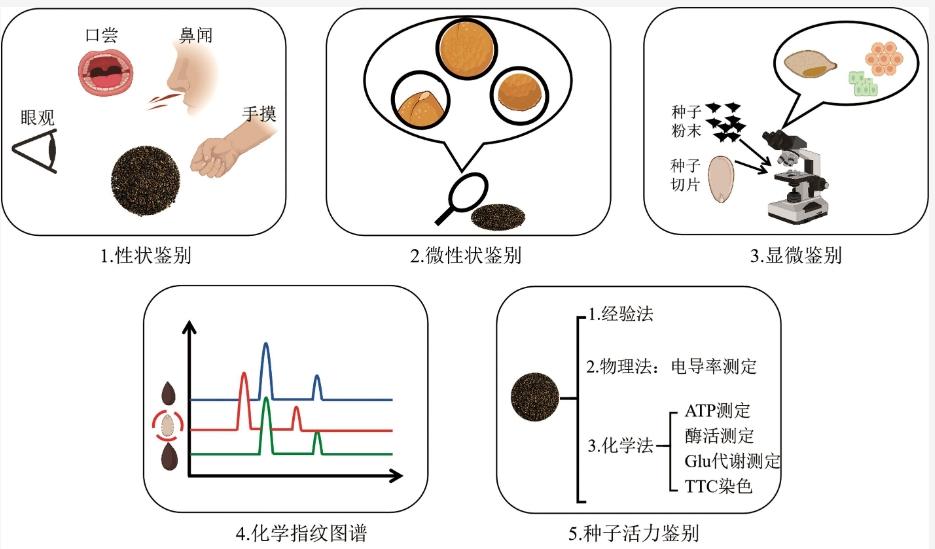
Abstract:Seeds are the source for the production of Chinese medicinal materials. The seed authenticity and quality of directly affect the effectiveness and safety of Chinese medicinal materials. The seed quality is faced with the problems such as mixed sources, existence of adulterants and seeds stocked for years, low maturity, and low purity. To ensure the high-quality and sustainable development of the Chinese medicinal material industry, it is urgent to standardize the seed market and identify and evaluate the quality of the seeds circulating in the market. Seed identification methods include visual inspection, microscopic observation, micro-character identification, chemical fingerprinting, molecular identification, electronic nose, X-ray diffraction, electrochemical fingerprinting, spectral imaging, and artificial intelligence. These methods have different application scopes and unique advantages and disadvantages. According to the different species of Chinese herbal medicines and different requirements of testing sites, suitable methods can be selected to achieve rapid and accurate identification with low costs. In the future, the seed identification methods should be developed based on emerging technologies with interdisciplinary knowledge, and intelligent, nondestructive, and single-grain detection methods are needed for the modern Chinese medicinal material industry. This paper introduces the seed identification technologies currently applied in research and production, compares the principles, applicability, advantages, and disadvantages of different technologies, and provides an outlook on the future development of seed identification technologies, aiming to provide a reference for the identification and quality evaluation of seeds of Chinese medicinal material.Keywords:seeds of Chinese medicinal materials;conventional identification;molecular identification;chemical fingerprinting;electronic nose;spectral imaging;artificial intelligence534|428|1<HTML><H-PDF><L-PDF><XML>Updated:2024-01-15


